
Your Next Hormone Therapy Pill Could Be Made From Natural Gas
From Greenhouse Gas to Life-Saving Medicine: The Chemistry Breakthrough That Could Change Everything
4/27/20262 min read
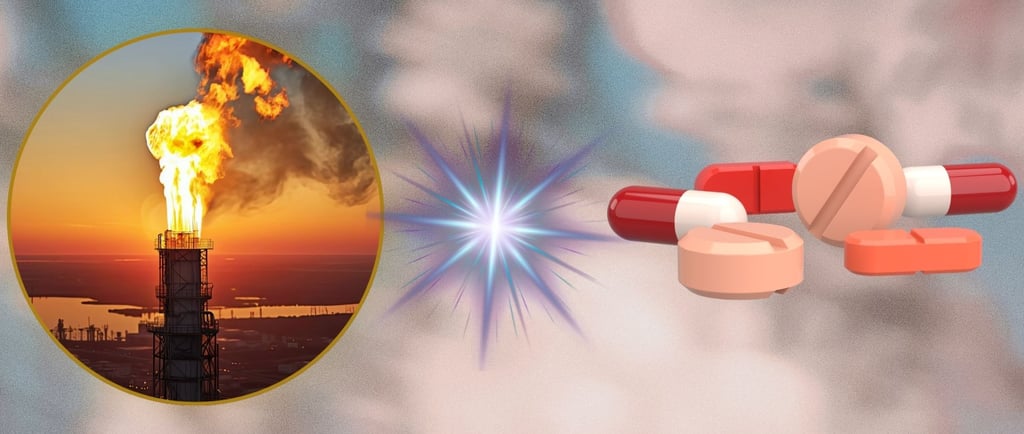
What if the Gas Warming Our Planet Could One Day be Used to Heal it?
In a stunning scientific breakthrough published in Science Advances, researchers in Spain have done something that was once considered nearly impossible: they turned methane — the primary component of natural gas and a potent greenhouse gas — directly into a pharmaceutical compound.
The Discovery
A team led by chemist Martín Fañanás at the Centre for Research in Biological Chemistry and Molecular Materials (CiQUS) at the University of Santiago de Compostela developed a new method to convert methane and other natural gas components into chemical "building blocks" — the raw ingredients used to manufacture medicines and other high-value products.
In a landmark first, they used this method to synthesize dimestrol, a non-steroidal estrogen used in hormone therapy, directly from methane. This had never been done before.
Why This Matters
Drug manufacturing today depends heavily on complex, expensive, and often environmentally costly petrochemical processes. This breakthrough could change that equation entirely.
Instead of relying on rare or toxic metals, the CiQUS team designed a clever iron-based catalyst — iron being one of the most abundant elements on Earth — powered by nothing more than LED light. The result is a cleaner, cheaper, and more sustainable way to make medicines.
Think about what that could mean: more accessible pharmaceuticals, lower production costs, and a chemical industry that finally starts working with the environment instead of against it.
Turning a Problem Into a Solution
Here's where it gets truly inspiring. Methane is one of the most damaging greenhouse gases on the planet. Right now, billions of cubic feet of it are burned off or released into the atmosphere every year with little productive use. This research points toward a future where we don't just burn methane — we transform it into something that heals people.
As Fañanás himself puts it, methane is constantly being generated — from animal waste, landfills, and industrial processes. If we don't capture and use it, it becomes a climate liability. But if we can turn it into medicine? That's a liability becoming an asset.
Still Early Days — But the Path Is Clear
This technology isn't hitting pharmacy shelves tomorrow. But as Science Advances research goes, this is the kind of foundational work that reshapes entire industries over the next decade. The European Research Council agrees — they're funding the broader project, called BECAME, specifically because of its global potential.
The vision: a circular chemical economy where abundant, low-cost natural gas becomes the feedstock for life-saving drugs, reducing emissions and reliance on traditional petrochemicals at the same time.
Read the original research: Science Advances — Attenuated LMCT photocatalysis enables C–H allylation of methane and other gaseous alkanes
Explore the full story on ScienceDaily: Scientists Turn Methane Into Medicine in Stunning Breakthrough
Sources: CiQUS / University of Santiago de Compostela, ScienceDaily, EurekAlert!, Science Advances (2026)